
Trump Accounts for Children under 18 Launched on July 4, 2026: What Parents Need to Know
August 2026

Allen Schaefer, CPA, MBA
On July 4, 2026, as the nation celebrated 250 years of American independence, a new opportunity for the next generation was unveiled: the launch of Trump Accounts, a savings and investment platform designed to give children under 18 a head start to building financial security from an early age.
What is a Trump Account?
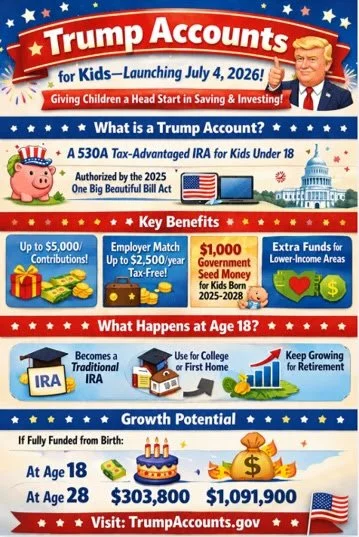
A Trump Account (also known as a Section 530A account) is a new type of tax-advantaged investment account for U.S. children under 18, designed to give them a financial head start and encourage long-term wealth building. A child can hold only one Trump account, which is linked to his/her Social Security Number.
Trump accounts were initially authorized in law by the 2025 One Big Beautiful Bill Act (OBBBA) and became available for initial deposits on July 4, 2026, on America's 250th Birthday. A Trump Account functions as a custodial traditional IRA (Individual Retirement Account) — the child is the legal owner. The adult (a parent, guardian, or other authorized person) acts as custodian until the child turns 18.
As of mid‑June 2026, more than 6 million American children have been signed up for Trump Accounts, according to the latest figures from the U.S. Department of the Treasury. Enrolling costs nothing.
What Parents Need to Know?
Eligibility: Any U.S. citizen child under 18 with a Social Security number is eligible for a Trump Account.
Activate an Account: To create a new Trump Account, parents, guardians, and other authorized individuals must first complete IRS Form 4547 for eligible children. If you filed IRS Form 4547 with your 2025 taxes this year, no further action is needed until you receive notification to activate your child's account. If not, you can file IRS Form 4547 through the Trump Accounts website or App or the IRS website. You will need the child's name, SSN, date of birth, address, and contact information. Identity verification steps are also required. The entire process should take 5-10 minutes to complete.
Contribute up to $5,000 Annually per Child: Parents, grandparents, relatives, and even employers can contribute up to $5,000 to each child's account each year. Additionally, certain governmental entities and charities may also make qualified general contributions to Trump Accounts, if given to a qualified class of account beneficiaries. A parent's employer may contribute up to $2,500 per year (which counts against the $5,000 annual limit) under an employer's Trump Account contribution program, and the contribution will not count toward the employee's taxable income. The annual contribution limits are indexed to inflation and will adjust starting after 2027.
Free Government Seed Money: $1,000 contribution from the U.S. Treasury: Children born between January 1, 2025 and December 31, 2028 are eligible to receive $1,000 in pilot program contributions from the U.S. Treasury, making the program particularly attractive for young families. The $1,000 will not count against the $5,000 annual limit.
Additionally, children including those who wouldn't qualify for the $1,000 contribution may be eligible to receive money if they live in a ZIP code where the median income is below a certain amount, courtesy of generous private individual and corporate donors that include $6.25 billion from Michael Dell, $250 million from Micron, two million shares of SpaceX stock valued at $325 million, $75 million from Ray Dalio, with a growing number of employers announcing that they will match contributions for their own employees' children.
Limited Investment Choices: Money in a Trump Account must be invested in mutual funds or ETFs that track a broad U.S. equity index (like the S&P 500) and use no leverage. While this promotes simplicity and diversification, it limits investor flexibility. Because the assets are invested in stock market funds which are subject to market risk, there is no guarantee that the account will increase in value.
Tax Deferral Growth: With a Trump Account, annual taxes are generally avoided while the funds remain invested, allowing the entire account balance to continue growing. Over periods of 18 years or longer, this can produce a meaningful difference in accumulated wealth.
Distributions Are Taxable: Distributions are restricted until the child reaches age 18. After that, distributions are taxable. As with any Traditional IRA, withdrawals that do not qualify for an exception would be subject to an additional 10 percent early distribution tax until the account owner reaches the age of 59.5 years old.
The portion of each withdrawal consisting of contributions made by individuals (parents or family) is considered "basis" and is tax-free when withdrawn. The portion of each withdrawal consisting of employer, charitable, or state and local contributions or account earnings is subject to ordinary income taxes.
What happens at Age 18? When the child turns 18, their Trump Account is treated as a traditional IRA. At age 18, the child can legally take custody of the account and decide on what to do with the money. At age 18, the parent or guardian cannot prevent withdrawals and no longer makes investment decisions.
Option #1: Withdrawals allowed – The child may choose to withdraw funds for eligible expenses. If your child takes money out before age 59½, they typically owe an additional 10% penalty on top of income tax. Withdrawals for eligible expenses, like higher education, a first home, or medical expenses, are taxed at ordinary income rates with no additional penalty. Additional state income taxes may apply.
Option #2: Continued Growth in a Traditional IRA – The child may choose to let their investments grow, tax-free, and save for retirement. At age 18, most of the special rules for Trump Accounts no longer apply, and the account will transition to a traditional IRA and generally is subject to the same rules as other traditional IRAs. At retirement, withdrawals are taxed as ordinary income.
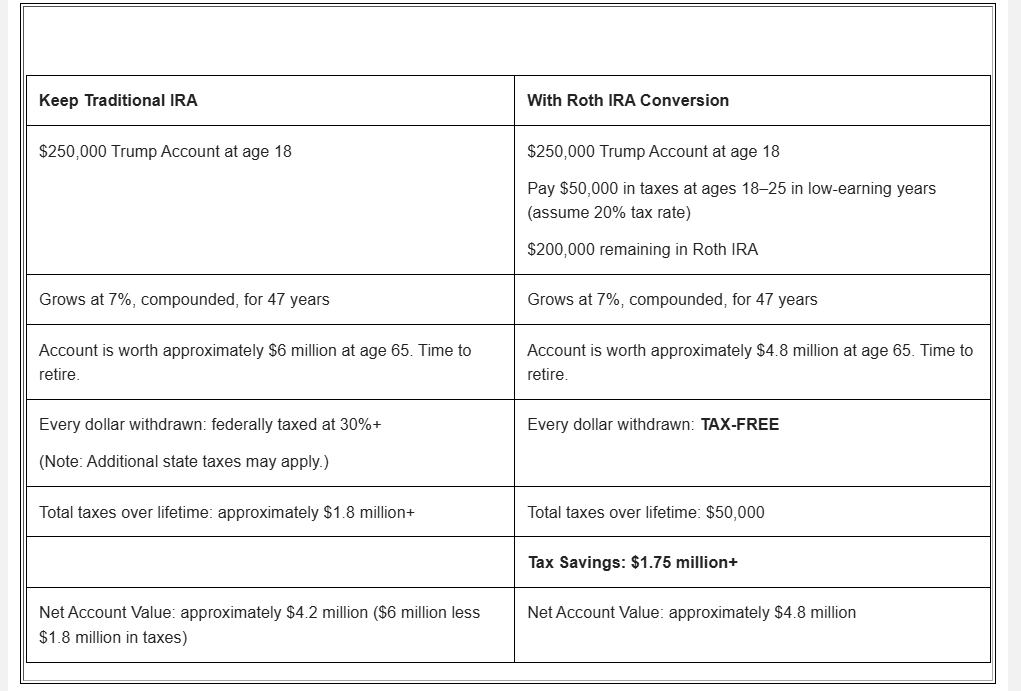
Option #3: Convert the Traditional IRA to a Roth IRA - At age 18, a Trump Account holder would likely be in a low tax bracket, making this an opportune time to convert the account into a Roth IRA, a taxable event. Selecting a Roth IRA conversion would allow the young adult to pay taxes immediately upon the conversion and then enjoy tax-free growth and withdrawals in retirement. The conversion can be done gradually to manage tax brackets, especially if the young adult has low earned income – say from a part-time or entry-level job.
Kiddie Tax: Be aware of the "kiddie tax," which applies to unearned income over a threshold ($2,700 in 2026). Conversions exceeding this amount may be taxed at the parents' marginal rate if the child is still claimed as a dependent on the parents' tax return.
At Age 18 should the Child keep a Traditional IRA or Convert to a Roth IRA?
Contributions to Trump Accounts will Not be subject to Gift Tax reporting, With Limitations.
The IRS recently issued Revenue Procedure 2026-25, which creates a safe harbor rule that treats certain contributions to Trump Accounts as completed gifts that are not future interests. As a result, parents, guardians, grandparents, and others can contribute up to $5,000 a year in after-tax dollars to a Trump Account, and they will not be required to file a gift tax return. To qualify for the safe harbor in a given year, a donor must meet several requirements. The donor must be an individual, and their total gifts to any single person during the year must not exceed the annual gift tax exclusion amount ($19,000 for 2026). If your contributions or gifts to the donee go above the $19,000 threshold - say you add $5,000 to the Trump Account, and add $10,000 to a 529 plan and a $5,000 cash gift - then you'll have to file a Form 709 gift tax return.
How Does a Trump Account Compare to a 529 Plan?
Families whose primary goal is education funding (i.e., college, trade school, graduate school, or other qualifying education) may still find a 529 plan more attractive because of its education-focused tax advantages for qualified educational expenses, higher contribution limits, and state income tax deduction benefits. Families whose primary goal is general wealth-building for a child may find the Trump Account more attractive.
Whether your goal is college, retirement, or general wealth-building, it's a good idea to open both a Trump Account and a 529 Plan if your budget allows it. To raise the next generation, parents, grandparents, and other individuals and employers can get involved early and help build financial security for a child from an early age. The adage "it takes a whole village to raise a child" highlights this.
How Much a Trump Account Could Grow Over Time?
The White House Council of Economic Advisors (CEA) estimates growth targets based on historical U.S. stock market returns. If maximum contributions are made to a Trump account belonging to a child born in 2026, the CEA estimates that the Trump Account would reach $303,800 by age 18 and $1,091,900 by age 28 in a medium-returns stock market scenario; view charts.
At Perelson Weiner, we work closely with our clients to identify tax-savings opportunities, cash flow needs, retirement goals, and plan for their loved ones' future. For additional information, please contact your Perelson Weiner professional.